I keep hearing the same thing: "Text news is dying."
Social media is taking over. Gen-Z watches everything. AI will replace publishers. Traditional news websites are finished.
Here's the truth: Everyone saying this is looking at the wrong data.
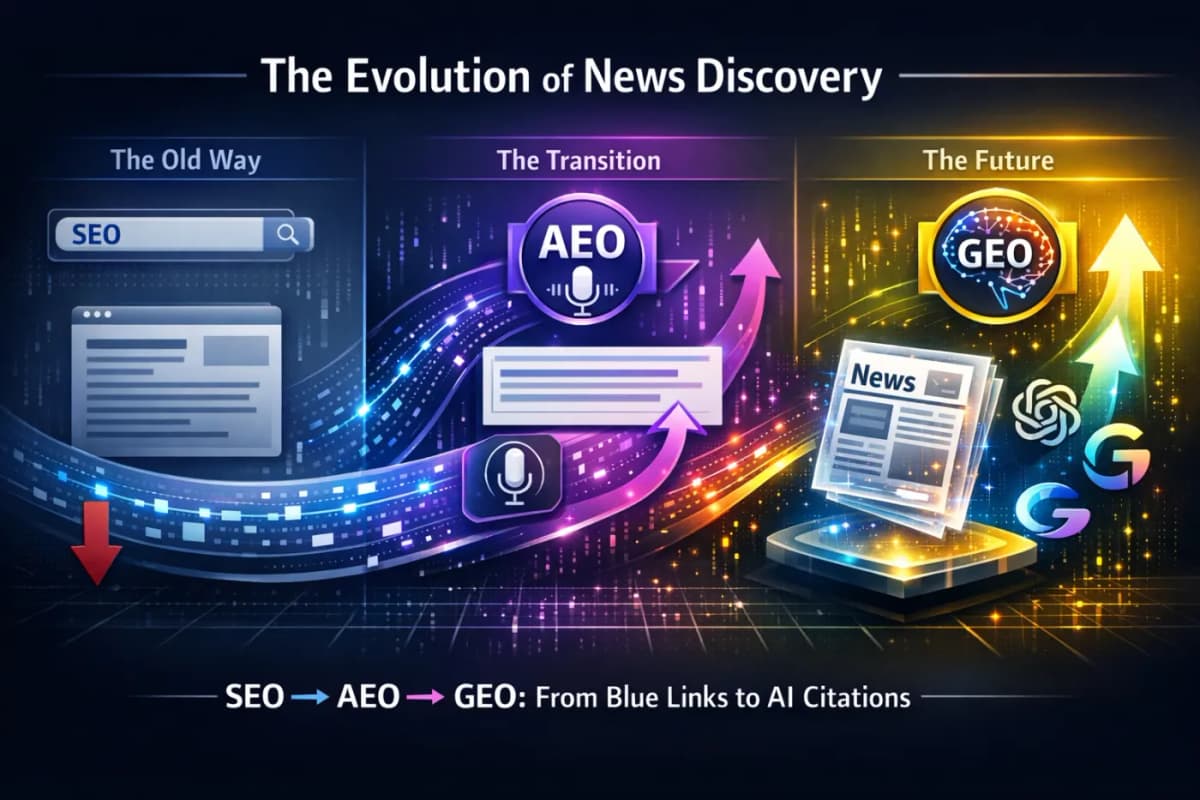
Text news isn't dying. It's evolving. And the publishers who understand this evolution—who master the shift from SEO to AEO to GEO—will own the next decade.
The ones who don't? They're already dead. They just don't know it yet.
The Numbers That Tell the Real Story
Let me show you what's actually happening:
Google Discover now delivers 67.5% of news traffic. Traditional web search dropped from 51% to just 27.4% in two years. That's not text dying—that's discovery channels changing.
40% of Malaysians use TikTok for news weekly. But here's what they don't tell you: 73% of those same users also Google the story afterward to verify it. Social spreads. Websites verify.
95.5% of internet users watch online video weekly. True. But video watch time averages 38 seconds. The average text article reader spends 2-3 minutes. Which one actually consumed your content?
The narrative that text is dying misses the point entirely. Text isn't competing with video. Text is the SOURCE MATERIAL for everything else.
Section 1: The Parasitic Truth—AI Needs You More Than You Need It
Here's what nobody's talking about: AI can't create news. It can only summarize it.
Think about it. ChatGPT, Gemini, Claude—every AI you've heard of—they all need one thing to function: fresh, accurate, text-based news content.
Training Data Gets Stale Fast
GPT-4's knowledge cutoff means anything from the last 6 months doesn't exist in its base model. When someone asks "What happened in the election?" or "What's the latest on the budget?" the AI has to pull from... where exactly?
News websites. Your news website.
Without publishers creating fresh, verified text content daily, AI systems are just expensive hallucination machines.
The Citation Wars Have Begun
OpenAI's SearchGPT, Google's AI Overviews, Perplexity—they're all scrambling to cite sources properly now. Why? Because users don't trust AI answers without attribution.
And here's the kicker: Publishers with the best structured data win the citation lottery.
When Gemini or ChatGPT answers a question about Malaysian politics or tech policy, they NEED to link back to credible sources. That's you. That's your traffic. That's your revenue.
Why AI Can't Replace Publishers (And Never Will)
AI can't:
- Attend parliament sessions
- Interview ministers or whistleblowers
- Break corruption scandals
- Access document leaks
- Provide cultural context for Malaysian politics
- Take legal accountability for published information
Local expertise isn't replicable by training data. The relationships journalists build, the sources they cultivate, the institutional knowledge they develop—AI can scrape the web, but it can't DO journalism.
When AI hallucinates wrong information about a political scandal, who gets sued? No one. When you publish it, you're accountable. That accountability is exactly why readers will always need you.
Section 2: SEO is Dead. Long Live AEO. Meet GEO.
If you're still optimizing for "blue link" Google rankings in 2026, you're fighting yesterday's war.
The search landscape has fractured into three distinct battlegrounds:
SEO (Search Engine Optimization)
Traditional keyword rankings. Still relevant, but shrinking. Zero-click searches now represent 25.6% of all searches—up from 8% in 2020. That's a lot of traffic you're optimizing for but never seeing.
AEO (Answer Engine Optimization)
Featured snippets, voice search answers, "People Also Ask" boxes. This is where AI assistants pull their responses from. When someone asks Siri or Alexa a question, they're reading YOUR content—but you might get zero clicks.
GEO (Generative Engine Optimization)
The new frontier. Optimizing content so AI systems CITE you in their responses AND drive clicks through "read more" prompts. This is where the game gets interesting.
Here's How They Work Together
Think of it as a funnel:
SEO builds foundational authority. Your domain strength, backlink profile, technical health—this is table stakes. Without it, you don't even get considered.
AEO captures quick answers. Your content is structured to extract clearly. Schema markup, FAQ sections, bullet summaries—this gets you INTO AI responses.
GEO earns trust from LLMs. Entity recognition, author authority, comprehensive coverage, fresh updates—this gets you CITED and CLICKED from AI summaries.
Most publishers are stuck at SEO. The smart ones moved to AEO two years ago. The ones who will dominate 2027? They're already mastering GEO.
The Technical Implementation
Here's what GEO actually looks like in practice:
Entity-rich content over keyword stuffing: AI understands that "Prime Minister" = "Anwar Ibrahim" = "Malaysian PM." Write for comprehension, not keyword density.
Structured data on steroids: JSON-LD isn't optional anymore. NewsArticle schema, FAQPage schema, author entity markup—if AI can't PARSE your content structure, it can't USE it.
Answer-first architecture: The inverted pyramid journalists already use? Perfect for AI extraction. Key facts first, context after. This is exactly how GEO works.
Fresh updates matter more than ever: AI prioritizes recently updated content. Last modified dates, article update logs, timestamp accuracy—these signals matter.
The Revenue Threat Nobody's Talking About
Here's the brutal reality: If your content gets cited but not clicked, you make zero dollars.
Google's AI Overview shows answers without sending traffic. Perplexity does the same. ChatGPT Search pulls your content and displays it beautifully formatted—with no ad revenue for you.
This is why GEO isn't just about getting cited. It's about getting CLICKED after citation. The "read more" link. The full article prompt. The verification source.
Publishers who nail this balance—being valuable enough to cite but compelling enough to click—they win. Everyone else fights over scraps.
How to Measure Success
Different optimization layers need different metrics:
| Metric Type | What to Track | Why It Matters |
|---|---|---|
| SEO | Organic traffic, keyword rankings, backlinks | Foundation authority |
| AEO | Featured snippet wins, PAA appearances, voice search citations | Quick answer dominance |
| GEO | AI tool citations, "read more" clicks, LLM source appearances | Future-proof positioning |
If you're only tracking pageviews and keyword rankings, you're missing 70% of the game.
Section 3: The Social Media Paradox
90% of users consume news on social media. Yet trust in social platforms is at an all-time low.
This creates the single biggest opportunity for publishers in a decade.
Why Social Can't Win Long-Term
Platform dependency is a death sentence. Remember Facebook Instant Articles? Publishers built entire strategies around it. Facebook killed it overnight. Traffic gone.
TikTok could get banned tomorrow. Instagram's algorithm changes monthly. X's engagement is a black box. Building your entire distribution on rented land is suicide.
The verification gap is real. When news breaks on Twitter, what do serious readers do? They Google it. They find the actual source. They verify.
Social spreads fast. Websites verify accurately. Both matter. But only one makes money.
The Misinformation Battlefield
AI is both the weapon and the shield here.
The threat: AI-generated fake news, deepfakes, synthetic articles flood social media at scale. A high school kid with ChatGPT can create 100 convincing-but-false articles in an hour.
The advantage: Publishers with AI-powered fact-checking can verify faster than ever. While social media drowns in misinformation, your newsroom's verification becomes a trust signal people are willing to pay for.
Trust = subscriptions. Trust = premium ad rates. Trust = survival.
Section 4: AI as Newsroom Force Multiplier
This is where it gets practical. Let me show you what AI actually does in a real newsroom.
The Workflow Revolution
Let me break down what publishing ONE news story requires:
TRADITIONAL WORKFLOW:
Phase 1: Core Article (30 mins)
- Tip/event breaks
- Reporter files bullet points + photos (10 mins)
- News desk writes first draft (15 mins)
- Sub editor + editor quick review (5 mins)
- Publish in English
Phase 2: Translations (1 hour, parallel)
- BM translator writes + review (20 mins)
- Chinese translator writes + review (20 mins)
- Tamil translator writes + review (20 mins)
Phase 3: Video Production (3-4 hours)
- Script writer adapts article (45 mins)
- Script review (15 mins)
- Camera + anchor record (30 mins)
- Video editor adds clips, b-roll, graphics (1.5-2 hours)
- Final review (15 mins)
Phase 4: Social Distribution (10 mins)
- Format video for platforms (5 mins)
- Write captions (3 mins)
- Upload (2 mins)
Total: 5-5.5 hours with 15-20 people
AI-AUGMENTED WORKFLOW:
Phase 1: Core Article (20 mins)
- Tip/event breaks
- Reporter files bullet points + photos (10 mins)
- AI generates first draft (30 seconds)
- AI suggests 5-7 optimized headlines (10 seconds)
- News desk reviews AI draft (5 mins)
- Sub editor + editor review (4 mins)
- Publish in English
Phase 2: Translations (5 mins)
- AI translates to BM, Chinese, Tamil simultaneously (1 min)
- Quick sub editor review of translations (3 mins)
- Publish all language versions (1 min)
Phase 3: Video Production (10 mins)
- AI generates video script (1 min)
- Script review (2 mins)
- AI creates faceless video with voiceover, b-roll, graphics (5 mins)
- Final approval (2 mins)
Phase 4: Social Distribution (5 mins)
- AI formats video for all platforms (1 min)
- AI writes platform-specific captions (30 seconds)
- AI publishes across platforms (2 mins)
- AI shares text links (1 min)
Total: 40 mins with 6-8 people
The Impact
| Metric | Traditional | AI-Augmented | Improvement |
|---|---|---|---|
| People Required | 15-20 | 6-8 | 60% reduction |
| English Article | 30 mins | 20 mins | 33% faster |
| All 4 Languages | 1.5 hours | 25 mins | 72% faster |
| Video Ready | 4-5 hours | 30 mins | 87% faster |
| Full Multi-Platform | 5-5.5 hours | 40 mins | 87% faster |
Why This Matters: The Breaking News Advantage
Scenario: Major political announcement at 2:00 PM
Traditional newsroom:
- 2:00 PM - Story breaks
- 2:30 PM - English article live ✓
- 3:30 PM - All 4 languages live ✓
- 6:30 PM - Video ready ✓
AI-augmented newsroom:
- 2:00 PM - Story breaks
- 2:20 PM - English article live ✓
- 2:40 PM - All 4 languages + video live ✓
You own the breaking news cycle across ALL formats while your competitor is still editing their video.
The Real Competitive Advantage
It's not about being first with text anymore. Everyone's fast with text.
It's about being first with video, translations, and multi-platform distribution while MAINTAINING quality. That's the new bar.
What AI Actually Does vs What Humans Must Do
AI handles:
- First draft generation (structure, flow)
- Translation (instant, 4 languages)
- Headline optimization (A/B testing)
- Video assembly (script → voiceover → b-roll → final cut)
- Multi-platform formatting and distribution
Humans STILL do:
- News judgment (is this story worth covering?)
- Source verification (is the tip credible?)
- Editorial review (does this meet our standards?)
- Cultural context (do translations maintain meaning?)
- Final approval (legal liability and accountability)
Critical point: Humans control quality. AI controls speed.
The Resource Math
One story, traditional way: 15-20 people × 5.5 hours = 82.5-110 person-hours
One story, AI way: 6-8 people × 40 mins = 4-5.3 person-hours
On a busy news day (20 stories):
- Traditional: 1,650-2,200 person-hours
- AI-augmented: 80-106 person-hours
That's not incremental improvement. That's transformation.
The Cost Savings Are Real
Let me give you actual numbers:
Translation costs:
- Manual: RM0.30/word × 1000 words × 3 languages = RM900/article
- AI: RM0.01/word × 1000 words × 3 languages = RM30/article
- Savings: 97%
Video production:
- Traditional: Camera operator + anchor + editor + 4 hours = RM500-800/video
- AI faceless: RM10/video
- Savings: 98%
Headline optimization:
- Traditional: 1 editor writes 1 headline, hopes it works
- AI: Generate 50 variants, test performance, use winner
- Result: 15-30% higher CTR
Do the math across 50-100 articles daily. The savings compound fast.
Section 5: The Format Fallacy
Yes, Gen-Z watches short-form video. Yes, TikTok is huge. Yes, attention spans have shortened.
But here's what the "video killed text" crowd misses:
Video is for discovery. Text is for depth.
The Complementary Model Works
Think about how actual news consumption happens:
- See 30-second TikTok about budget announcement
- Get curious about details
- Google "Malaysia budget 2026"
- Read full 1,200-word analysis
- Share specific quote with colleagues
The TikTok got attention. The text article delivered VALUE. Both matter.
Text Has Advantages Video Never Will
Searchability: You can't Ctrl+F a video. You can't copy-paste a quote from a news anchor. Text is functional in ways video fundamentally isn't.
Accessibility: Video without captions excludes deaf readers and violates accessibility laws. Text is inclusive by default.
Bandwidth economics: In rural areas with expensive data, text loads. 4K video doesn't. 88% smartphone penetration doesn't mean 88% have unlimited data.
Speed of consumption: I can skim a 1,000-word article in 90 seconds and extract what I need. A 90-second video forces me to watch the whole thing.
The Data Speaks
Malaysian mobile users:
- 67% access internet primarily via smartphone
- 50% of e-commerce traffic is mobile
- Average 3+ hours daily online
- BUT text-based news sites load 5-10x faster than video-heavy sites
Engagement patterns:
- Video watch time: 38 seconds average
- Text article read time: 2-3 minutes average
- Newsletter open rate: 25-40%
- Social video completion rate: 12-15%
Which format is actually keeping attention?
AI Lets You Have Both
Here's the killer insight: Your text article IS the source material for faceless videos.
Write once. Publish everywhere:
- Full text article on website
- AI-generated 60-second video for TikTok
- AI-generated 30-second reel for Instagram
- AI-generated carousel for LinkedIn
- AI-generated newsletter summary
That's not choosing between formats. That's owning ALL formats from one piece of journalism.
Section 6: The Malaysian Opportunity
Here's what most publishers don't realize: Malaysia has unique advantages if you're willing to adapt.
Multi-Language is a Goldmine
Four official languages = 4x your addressable market.
With AI translation:
- Write once in English
- AI translates to BM, Chinese, Tamil in 2 minutes
- Publish simultaneously to 4x the audience
- Each language = separate indexed content = 4x SEO opportunity
Traditional publishers see translation as a cost center. AI-augmented publishers see it as a growth multiplier.
The Regulatory Environment Favors You
Social media platforms now need MCMC licenses. Fines up to RM500K for non-compliance. Content removal powers expanding.
What this means:
- Social media becomes LESS reliable for distribution
- Owned platforms (your website) become MORE valuable
- Compliance infrastructure you already have = competitive moat
First-Mover Advantage is Still Available
Most Malaysian publishers are still stuck in SEO-only mode. The shift to AEO is barely starting. GEO? Hardly anyone's even thinking about it.
That means you can be the first.
The first to properly structure content for AI extraction. The first to master multi-language AI translation at scale. The first to build AI-powered fact-checking workflows. The first to implement full GEO optimization.
Being first in this space isn't about billions in R&D. It's about understanding what's changing and moving BEFORE your competitors.
The Choice
You have three options:
Option 1: Ignore AI and hope it goes away
Result: Blockbuster. Kodak. Pick your cautionary tale.
Option 2: Adopt AI tools randomly without strategy
Result: Waste money on features that don't move metrics. Get no competitive advantage.
Option 3: Systematically transform with SEO→AEO→GEO
Result: You own the next decade.
Text news isn't dying.
Lazy publishers are.
The ones who refuse to evolve from SEO to AEO to GEO. Who can't see that AI needs them more than they need AI. Who think social media is a replacement instead of a complement. Who believe video killed text instead of seeing them as two parts of the same ecosystem.
Meanwhile, the publishers who get it—who use AI to multiply journalist productivity, who optimize for answer engines and generative engines, who build multi-language strategies, who maintain quality while increasing speed—they're building something that will last.
The future of news isn't AI vs. humans.
It's AI-augmented journalists outcompeting everyone else.
Which side are you on?
Key Takeaways
-
AI can't replace publishers — LLMs need fresh, verified text content to function. Without news websites, they're just expensive hallucination machines.
-
SEO → AEO → GEO — The optimization game has three layers now. Master all three or get left behind.
-
Social spreads, websites verify — 90% consume news on social, but trust is at all-time lows. Verification is your competitive advantage.
-
AI multiplies journalists, not replaces them — 87% faster multi-platform publishing with 60% fewer people. But humans still control quality and accountability.
-
Text is the source material — Write once, AI converts to video/audio/infographic. Stop choosing between formats. Own them all.
-
Multi-language = 4x market — AI translation drops costs 97%. Each language is separate SEO opportunity.
-
Breaking news speed is the new bar — Being first with text is table stakes. Being first with video + translations + multi-platform = market leader.
Need help transforming your newsroom with AI? These aren't theoretical strategies. This is what actually works in production at scale.
Let's talk → Contact Me
Found this useful? Share it with your network on LinkedIn | Twitter
About the Author
Mohit Shrivastava is Head of IT with 18+ years of experience building platforms that serve millions. He led platform development that achieved 184% traffic growth while reducing costs 75%. Top 3% contributor on StackOverflow. Specialized in Next.js, performance optimization, and news media technology.