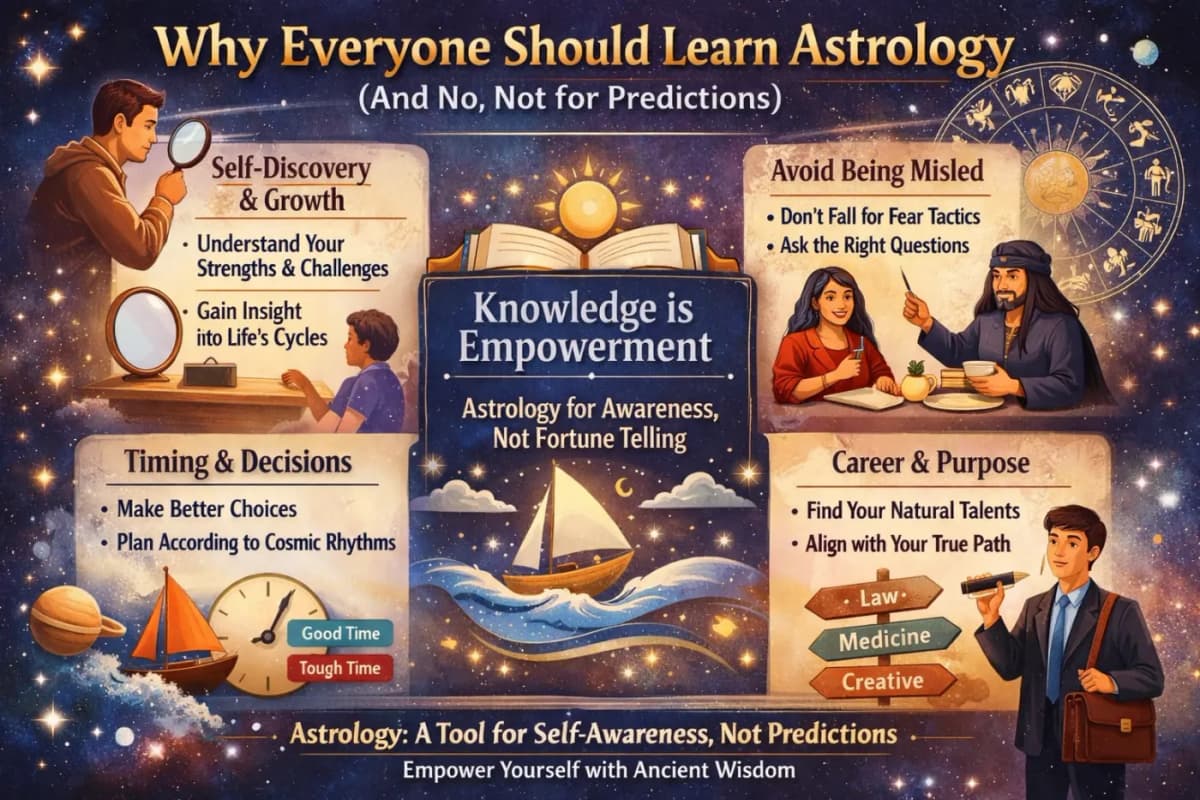
Why Everyone Should Learn Astrology (And No, Not for Predictions)
Let me tell you something that might sound counterintuitive.
I've been studying Vedic astrology for years. And if there's one thing I'd tell anyone starting this journey, it's this: don't learn astrology to predict the future.
Wait, what?
Stay with me here. This is actually the most important thing I can teach you about astrology—and it has nothing to do with reading birth charts or calculating planetary positions.
The Real Reason to Learn Astrology
Here's what astrology actually gives you: a deeper understanding of yourself.
Think of it as a framework for self-discovery. A tool for healing. A mirror that shows you patterns you couldn't see before.
When you learn astrology at even a basic level, you start seeing yourself differently. You understand why certain phases of your life felt like swimming upstream while others felt like sailing with the wind. You recognize your natural strengths—and the areas where you'll always need to work harder.
This isn't fortune-telling. This is self-awareness.
"But Why Not Just Go to an Astrologer?"
Here's where it gets interesting.
When you feel unwell, you go to a doctor. The doctor has spent five to seven years studying medicine. They have certifications. They've passed rigorous examinations. When they give you advice, there's an entire system that validates their expertise.
Now think about astrologers.
I'll be honest with you. Some of the astrologers practicing today have barely graduated high school. They've picked up bits and pieces of knowledge—incomplete knowledge—and they're using that to advise you on life-changing decisions.
This isn't to dismiss all astrologers. There are brilliant practitioners out there who've dedicated decades to studying this science. But here's the problem: you can't always tell the difference.
An astrologer with half-baked knowledge will look at your chart, see some planetary combinations they half-remember, and start scaring you.
"Oh, your Mangal (Mars) is in this position... very bad."
"Shani (Saturn) is affecting your seventh house... marriage will be difficult."
"Rahu is creating problems... you need to do this expensive ritual."
And suddenly, you're terrified. You're making decisions based on fear. You're spending money on remedies that may or may not work—all because someone with incomplete knowledge looked at your chart through a narrow lens.
The Case for Astrological Literacy
Dr. K.N. Rao, one of the most respected Vedic astrologers in the world, has long advocated for something radical: astrology should be taught in schools.
Not to create astrologers. But to create informed citizens.
Think about it. We teach children mathematics they'll rarely use in daily life. We teach them the periodic table, historical dates, and grammar rules. All useful in their own way.
But we don't teach them this ancient science that their ancestors developed over thousands of years. A science that can help them understand themselves, their rhythms, their natural tendencies.
Dr. Rao's point is simple: if your child grows up with even basic astrological literacy, no half-baked astrologer can manipulate them with fear. They'll know enough to ask logical questions. They'll understand when something doesn't make sense.
"You say Mars is bad in my chart. But Mars is exalted here. Why would that be a problem?"
"You're predicting difficulties because of Saturn. But isn't Saturn in its own sign? What specifically are you seeing?"
This is the power of basic knowledge. It protects you from being exploited.
Beyond the practical self-defense, there's something deeper here. Learning astrology connects you to your roots. To Sanatan Dharma. To the philosophical traditions that your ancestors developed and refined over millennia. It's a doorway into understanding the Hindu conception of time, karma, and the dance between destiny and free will.
"If Everything Is Already Written, Why Bother Knowing?"
Now here's the question everyone asks. And it's a fair one.
According to astrology, certain things are predetermined. Your birth time, your planetary positions, the broad strokes of your life's journey—these are set. If you can't change what's written, what's the point of knowing it?
Let me answer this with an example everyone can relate to.
The Cricketer's Form
Virat Kohli. Sachin Tendulkar. Any elite athlete you can think of.
Have you noticed how commentators talk about their "form"? Sometimes these players are on fire—every ball they hit finds the boundary. Other times, they struggle to get off the mark.
Now here's the question: did they forget how to bat?
Of course not. Their skills haven't changed. Their practice routines are the same. Their physical ability is unchanged. Yet their performance fluctuates dramatically.
This is what astrology would call dasha—the planetary periods that influence the flow of your life.
Even with the same skills, the same effort, and the same preparation, there are times when everything clicks and times when nothing does. Elite athletes have learned to navigate this. They know that bad patches pass. They don't make drastic changes when they're in a slump.
Now imagine if you had a framework to understand these cycles in your own life.
Timing Your Moves
Here's where it gets practical.
If you know that the next eighteen months are favorable for career risks, you might pursue that startup idea you've been sitting on. If you know the next two years are better for consolidation rather than expansion, you might focus on strengthening what you already have instead of chasing growth.
This isn't about avoiding action during "bad" periods. It's about calibrating your expectations and your effort to match the cosmic weather.
Think of it like sailing. You can sail in any wind. But if you know a storm is coming, you prepare differently. You adjust your sails. You plan your route. You don't just charge ahead pretending the weather doesn't matter.
The Right Direction
Here's something that bothers me deeply.
Parents pushing their children toward medicine when the child's chart clearly shows they'd thrive as a lawyer. Or vice versa. Years of struggle, countless entrance exams, mounting frustration—all because no one looked at what this person was naturally built for.
I'm not saying astrology should dictate career choices. But what if it could be one input? What if, alongside aptitude tests and counseling, parents and children had access to insights about natural inclinations?
A child who becomes a doctor when they should have been a lawyer will probably be a competent doctor. They'll survive. But they could have been an extraordinary lawyer. That's the opportunity cost of not knowing.
Your chart doesn't limit you. It shows you where you have the most potential. Where your energy flows most naturally. Where you're swimming with the current instead of against it.
Amplifying and Dampening: The Real Purpose of Prediction
So if certain things are fixed, what can you actually do with astrological knowledge?
Here's the key insight: you can influence the intensity of outcomes.
Imagine you see a period coming where accidents or health issues are indicated. You can't necessarily avoid all accidents. But you can:
- Be more careful while driving
- Schedule that surgery you've been putting off (when the chart shows it's not a major health dip)
- Avoid unnecessary risks during that window
- Be more attentive to your health
The accident might still happen. But maybe it's a fender bender instead of a major crash. Maybe the health issue gets caught early because you were paying attention.
Now flip it around.
Your chart shows a period favorable for financial growth. Instead of passive waiting, you actively pursue opportunities. You take calculated risks. You put yourself in positions where luck can find you.
What might have been a 2x return becomes a 6x return. Not because you changed your destiny, but because you amplified what was already favorable.
This is the practical application of astrology. Not passive acceptance. Active navigation.
How Deep Do You Need to Go?
Here's the good news: you don't need to become a master astrologer.
Learning astrology deeply is a lifetime's work. It's an ocean. Some of the greatest practitioners I know say they're still learning after forty years. The combinations are endless, the texts are vast, and the intuition required takes decades to develop.
But basic literacy? That's achievable.
Understanding the twelve houses and what they represent. Knowing the basic nature of the nine planets. Recognizing the difference between beneficial and challenging planetary placements. Understanding what dasha you're currently running.
This level of knowledge—which you can develop in a few months of serious study—is enough to protect you from charlatans and give you a new lens for understanding your life.
You don't need to become a doctor to understand when something a doctor says doesn't make sense. Similarly, you don't need to become an astrologer to have enough knowledge to ask the right questions.
The Takeaway
I've been studying astrology for years now. And the people I've seen benefit most aren't the ones trying to predict lottery numbers or marriage dates.
They're the ones who approach it as a tool for self-understanding. Who use it to make peace with their past and navigate their future with more awareness. Who learn just enough to protect themselves from fear-based manipulation and connect with an ancient wisdom tradition.
Astrology isn't about knowing the future. It's about knowing yourself.
And that knowledge? It's worth every moment you invest in learning it.
Mohit Shrivastava is a technology leader who studies Vedic astrology. He believes ancient wisdom and modern expertise can coexist—and often should. Learn it from a credible source. Just learn it.